

23 Things (now 24)
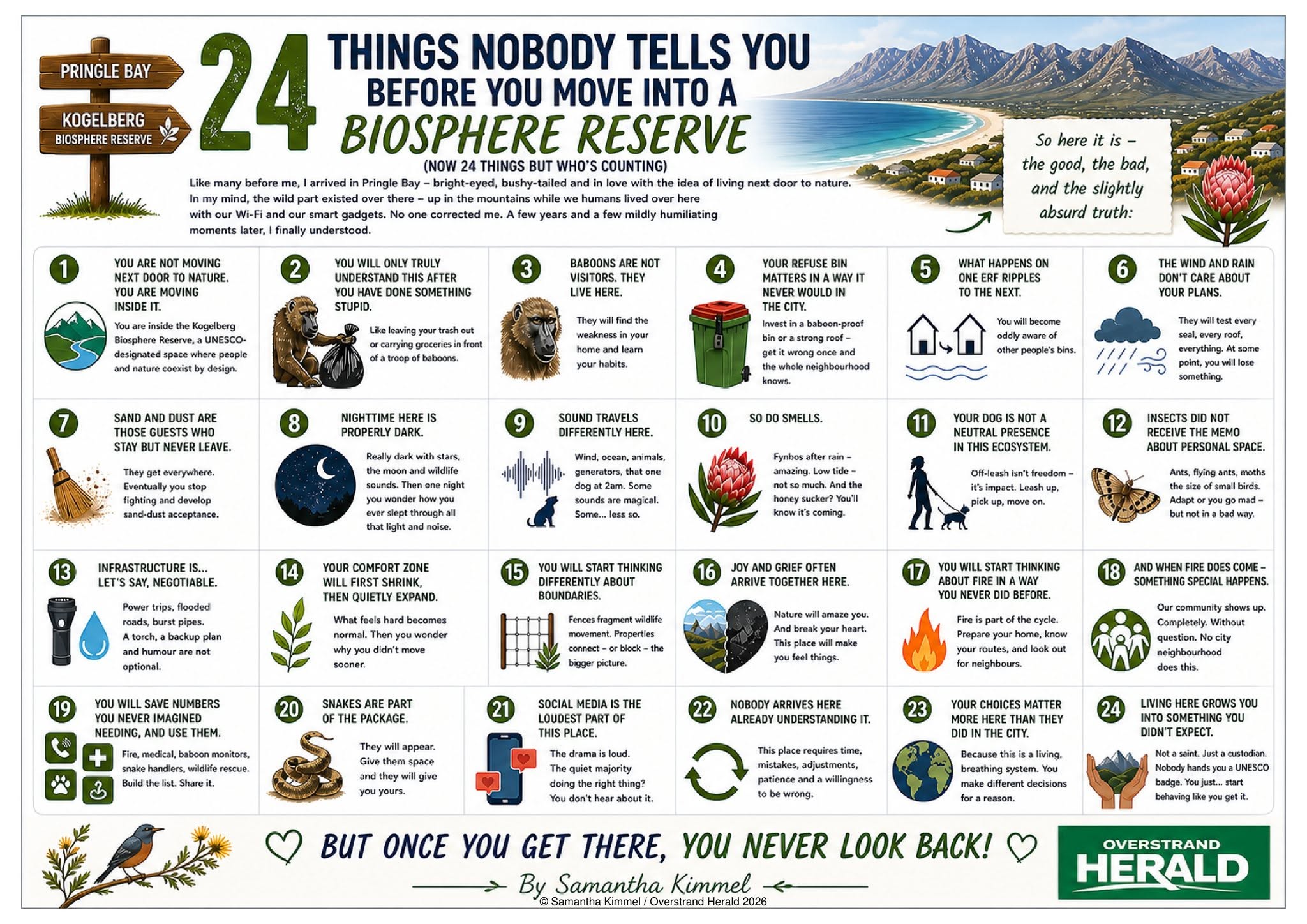
23 Things Nobody Tells You Before You Move into a Biosphere Reserve
(Now 24 things but who’s counting)
Like many before me, I arrived in Pringle Bay – bright-eyed, bushy-tailed and in love with the idea of living next door to nature. In my mind, the wild part existed over there — up in the mountains while we humans lived over here with our Wi-Fi and our smart gadgets.
No one corrected me.
A few years and a few mildly humiliating moments later, I finally understood.
So here it is — the good, the bad, and the slightly absurd truth:
1.
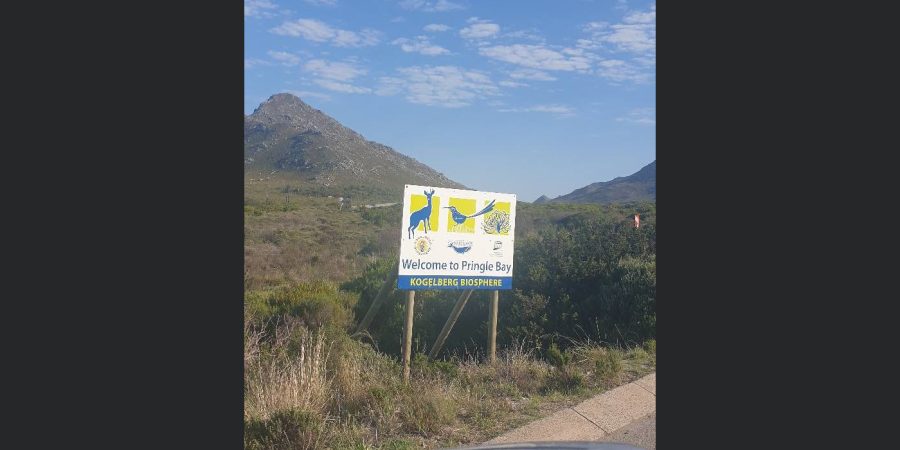
You are not moving next door to nature. You are moving inside it. Not next to the Kogelberg Nature Reserve — but inside the Kogelberg Biosphere Reserve, a UNESCO-designated space where people and nature are meant to coexist by design. This is the starting point of everything that follows. Everything.
2.
You will only truly understand this after you have done something stupid. Like leave your black bag full of trash on the pavement on refuse day. Or carry your groceries from the car to your kitchen in full view of a troop of highly motivated primates. It’s not just the action but the impact that is massive.
3.
Baboons are not visitors. They live here. They do not care about your opinions, your Facebook arguments or your newly installed cat flap. If there is a weakness in your design and in your chimney – they will find it. If there is a pattern to your habits, they will learn it. Until you learn. Until somewhat reluctantly, you adapt.
4.
Your refuse bin matters in a way it never would in the city. Here no one is impressed by the size of your house or the car you drive. But invest in a baboon-proof bin or a roof that withstands the rain and wind — and you have their attention. Get it wrong once and the whole neighbourhood knows.
5.
You will become oddly aware of other people’s bins. You don’t mean to. You just… do. Because what happens on one erf ripples to the next. This is not suburbia and consequences don’t end at your gate.
6.
The wind and rain do not care about your renovation plans. Or your anything. They will test every seal on your doors and windows, every roof sheet, even your patio furniture. At some point, you will lose something to the weather. Everybody does.
7.
Sand and dust are those guests who stay but never leave. They invade your house, your bed, your car – even your coffee. You sweep. You vacuum. They come back. Eventually you stop fighting this and develop what can only be described as sand-dust acceptance practice.
8.
Nighttime here is properly dark. Not city dark — that orange, never-quite-off kind of dark. Really, really dark with stars, the moon and wildlife sounds. It takes a while to adjust. And then one night you drive back from the city and you wonder how you ever slept through all that light and noise.
9.
Sound travels differently here. Wind, ocean, animals, generators, that one dog somewhere in the distance who has never once in its life felt heard. You become aware of sound in a way you simply weren’t before. Some of it is extraordinary. Some of it is that baboon bark at 2am and less welcome.
10.
So do smells. Fynbos after rain — genuinely one of the best things on earth. Low tide — less so. And the honey sucker? The less said, the better. Just know it’s coming and cross your fingers that your neighbours aren’t enjoying their weekend braai at the same time. They will judge you for it — but not in a mean way.
11.
Your dog is not a neutral presence in this ecosystem. Off-leash here is not freedom — it is impact. On the wildlife, on the fynbos, on the beaches and on your neighbours. Someone is always watching and someone may even photograph it. Leash up, pick up, clean up, move on.
12.
Insects did not receive the memo about personal space. Ants find their way into everything. Flying ants appear overnight in quantities that feel biblical. Moths the size of small birds show up uninvited. You adapt or you develop a very specific kind of madness — but not in a bad way.
13.
Infrastructure is… let’s say, negotiable. The power trips. The roads flood. Water pipes break. Not dramatically — but often enough to remind you that you are not living in a controlled city. A torch, a backup plan and a sense of humour are not optional extras here.
14.
Your comfort zone will first shrink, then quietly expand. Some things will feel like effort at first. Then they become normal. Then you drive into the city and sit in traffic staring at the concrete jungle and inhaling the pollution and you genuinely cannot remember why you didn’t move here sooner
15.
You will start thinking differently about boundaries. In cities fences and walls make good neighbours. Here, solid fencing fragments wildlife movement and cuts off corridors that animals have used for centuries. You start to see how properties connect — or block — the larger system. You start asking different questions. And yes — someone will absolutely tell you about wildlife-friendly fencing options before you’ve even asked. They mean well.
16.
Joy and grief often arrive together here. You will witness nature doing things that stop you in your tracks — things you couldn’t have imagined before you moved here. And you will also see what carelessness and human cruelty costs: things you cannot unsee. This place will make you feel things. That’s not a warning. That’s the deal.
17.
You will start thinking about fire in a way you never did before. The fynbos here is not just beautiful — it is a fire-adapted ecosystem that has been burning and regenerating for thousands of years. Fire is not a disaster waiting to happen. It is part of the cycle. But that doesn’t mean you cannot prepare: clear your gutters. know your escape routes. Keep your property defensible — not just for your sake, but for your neighbours’ and for the firefighters who will show up without hesitation when the smoke appears on the mountain. They are volunteers. Let that sink in.
18.
And when fire does come — even a distant threat of it — something special happens. The community that argues on social media, debates the bins and disagrees about the dogs and cats shows up. Completely and without question. People you have never met arrive to help. WhatsApp groups shift from complaints to coordinates and donations in minutes. It is the most humbling and clarifying thing you will witness here. No city neighbourhood does this. Not like this.
19.
You will save numbers you never imagined needing. And you will use them. Fire responders. Emergency services. Baboon monitors. Snake handlers. First Aid community responders and wildlife rescue. Build the list early. Share it with your neighbours. This is not pessimism — it is just how this community functions.
20.
Snakes are part of the package. They appear occasionally, without announcement and without apology. They will teach you more about focus and rapid decision-making than any mindfulness course ever could. The rule is simple: give them space and they will give you yours.
21.
Social media is the loudest part of this place — and often the least representative. The arguments, the drama, the photographs and tales of other people’s mistakes — none of that is the full picture. What it doesn’t show you is the quiet majority getting on with it: living mindfully, doing the right thing, day after day, without posting about it.
22.
Nobody arrives here already understanding it. This place requires time, mistakes, adjustments, patience, and a certain willingness to be wrong about things you were very sure about. That’s not a flaw — it’s the learning curve, and it belongs to everyone who has ever moved here — including the people who now seem like they were born all-knowing.
23.
Your choices matter more here than they did in the city. Not because someone is watching but because this is a living breathing system. You start making different decisions, not out of obligation, but because you begin to see why they matter.
24.
Living here grows you into something you didn’t expect. Not a conservationist, not an activist. Not a saint. Just someone who has learned — slowly, sometimes reluctantly — that being a resident here means becoming a custodian of it. Nobody hands you a UNESCO badge. You just… gradually start behaving like you understand what this place is.
BUT once you get there, you never look back!